

Reading the Daodejing: Chapter 2
(18 min read) New here? Check out the introduction, language primer, and historical context to get quickly up to speed. Chapter and text formatting is explained here.
This Substack assumes a basic standard of human decency. Those who are purposefully cruel, dehumanize others, show contempt for the law, or celebrate violence — or those who impose such people on the rest of us through political support — should not be here.
天下皆知美之為美, 斯惡已
皆知善之為善, 斯不善已
故:
有無相生, 難易相成
長短相較, 高下相傾
音聲相和, 前後相隨
是以聖人:
處無為之事, 行不言之教
萬物作 焉而不辭,
生而不有, 為而不恃, 功成而弗居
夫唯弗居, 是以不去
Mandarin & English
Here is the chapter with the pinyin and a character-by-character glossing interleaved between lines:
(1) 天下皆知美之為美,斯惡已。
tiān xià jiē zhī měi zhī wéi měi, sī è yǐ.
[Heaven][under]=world] [all] [know/understand] [beautiful] [’s] [do/act] [beautiful], [this/thus] [ugly/foul/bad] [already/stop].
(2) 皆知善之為善,斯不善已。
jiē zhī shàn zhī wéi shàn, sī bù shàn yǐ.
[all] [know/understand] [good/benevolent] [’s] [do/act] [good], [this/thus] [not] [good/benevolent] [already/stop].
(3) 故有無相生,難易相成,
gù yǒu wú xiāng shēng, nán yì xiāng chéng,
[thus] [have/there is/presence] [without/lack/absence] [each other/mutually] [birth/grow/life]; [difficult] [easy] [each other/mutually] [complete/accomplish];
(4) 長短相較,高下相傾,
cháng duǎn xiāng jiào, gāo xià xiāng qīng,
[long] [short] [each other/mutually] [compare]; [high] [low] [each other/mutually] [incline/lean];
(5) 音聲相和,前後相隨。
yīn shēng xiāng hé, qián hòu xiāng suí.
[tone/note] [noise/sound] [each other/mutually] [harmonize, blend]; [before/front] [after/behind] [each other/mutually] [follow].
(6) 是以聖人處無為之事,行不言之教;
shì yǐ shèng rén chǔ wú wéi zhī shì, xíng bù yán zhī jiào;
[[this/it][by means of]=therefore] [[sage, holy][person]=Sage] [dwell/occupy/handle] [without/lack] [act/do] [’s] [affair/matter/work]; [walk/perform/conduct] [not] [speak/words] [’s] [teaching/instruction].
(7) 萬物作焉而不辭,生而不有。
wàn wù zuò yān ér bù cí, shēng ér bù yǒu.
[[ten thousand][things/creatures]=all creatures] [arise/spring up/be made] [there/in this] [and/yet] [not] [decline, refuse, take leave of/speak of], [birth/produce] [and/yet] [not] [have/posses].
(8) 為而不恃,功成而弗居。
wéi ér bù shì, gōng chéng ér fú jū.
[do/act] [and/yet] [not] [rely on/presume/claim to], [achievement, merit] [complete/accomplish] [and/yet] [not] [dwell/occupy/residence].
(9) 夫唯弗居,是以不去。
fū wéi fú jū, shì yǐ bù qù.
[now/indeed, (man)] [only/precisely] [not] [dwell /occupy]; [[therefore]] [not] [depart/leave/remove].
The Shape (Seeing the Whole)
“Whosoever goes beyond False Knowledge is freed from ‘opposites’ such as Beautiful and Ugly, High and Low. From this Higher Knowledge flows a Life without Possession or Attachment.” — Liu Yiming (1734–1821) (via Minford)
Chapter 2 breaks cleanly into two parts. Very generally: lines 1-5 are about the mutual arising of opposites, and lines 6-9 are about how the wise don’t allow themselves to get caught up in valuing one side of an opposition over the other.
Each part breaks down further.
In the first part, lines 1-2 are a rough parallel structure and describe the process by which opposites mutually arise in human terms (and with the opportunity for two distinct readings, as we’ll discuss below) — once everyone knows the beautiful as beautiful, ugliness is already there; and once everyone knows the good as good, there is the not-good. Naming one half calls up the other.
Then in lines 3-5, six tightly parallel tetrasyllabic phrases — each sharing a third character, xiang 相 (“mutually”) — drive the point home with six examples. Having and lacking, difficult and easy, long and short, high and low, note and noise, before and after — each pair arises together.
The second part is more complex, with line 6 introducing “the Sage” (more about this character in the next section) and lines 7-9 describing how such a person behaves. Line 6 gives the principle — acting without doing, teaching without speaking — and 7-8 spell it out as a series of does-yet-doesn’t examples: produces but doesn’t possess, acts but doesn’t presume, finishes the work but doesn’t dwell in it.
The connection back to 1-5 is tighter than it might seem at first. If fixing on one side of a pair summons the other — if claiming “beauty” mints “ugliness” — then to grasp anything is to implicitly bind yourself to its opposite. So the Sage’s non-claiming isn’t an escape from the fact of opposites; it’s an escape from getting bound to one. And line 9 brings things back to the mutual oppositions of lines 1-5 by becoming an opposite-pair itself: 弗居 / 不去, “not dwell” / “not depart.”
Line by Line
The above is the shape of the chapter as I see it. But let’s take a closer look at the exact words and phrasings, as well as how others have interpreted and translated them.
Lines 1-2
(1) 天下皆知美之為美,斯惡已。
tiān xià jiē zhī měi zhī wéi měi, sī è yǐ.
[Heaven][under]=world] [all] [know/understand] [beautiful] [’s] [do/act] [beautiful], [this/thus] [ugly/foul/bad] [already/stop].
(2) 皆知善之為善,斯不善已。
jiē zhī shàn zhī wéi shàn, sī bù shàn yǐ.
[all] [know/understand] [good/benevolent] [’s] [do/act] [good], [this/thus] [not] [good/benevolent] [already/stop].
As I mentioned above, these lines show how once one defines something as beautiful or good, the opposite notion inevitably follows. Here’s Brook Ziporyn’s translation, which is in line with the majority of interpretations:
When all in the world know the beautiful to be beautiful, there already is the ugly.
When all know the good to be good, there already is the bad.
But there is an alternate reading, hinging on the absent verb in the last clause. Thomas Cleary provides a clean example:
When everyone knows beauty is beauty, this is bad.
When everyone knows good is good, this is not good.
The difference is where the stress falls. On the majority (and my) reading, to know the beautiful is to have minted the ugly — they arise as a matched set. On Cleary’s reading, it is the universal recognition of beauty-as-beauty that is the problem.
But these are less two rival readings than two faces of one thought, as Ziporyn points out in his notes. He says that “three related ideas suggested here: (1) By understanding a particular concept, the opposite concept is also necessarily understood, as a contrast. (2) Knowledge of a value... undermines the value of that value, makes it bad… (3) What generates the problem is not just a single individual’s awareness of the ideal, but the fact that all under heaven agree about these ideals.”
The three fold together: the collective knowing (3) mints the opposite (1), and in doing so spoils the value itself (2). Hold onto the idea that fixing a value is what corrupts it, because it is what the second half of the chapter will describe.
Red Pine keeps the ambiguity well, with his “if that… this becomes” allowing either reading:
All the world knows beauty
but if that becomes beautiful
this becomes ugly
all the world knows good
but if that becomes good
this becomes bad
Lines 3-5
(3) 故有無相生,難易相成,
gù yǒu wú xiāng shēng, nán yì xiāng chéng,
[thus] [have/there is/presence] [without/lack/absence] [each other/mutually] [birth/grow/life]; [difficult] [easy] [each other/mutually] [complete/accomplish];
(4) 長短相較,高下相傾,
cháng duǎn xiāng jiào, gāo xià xiāng qīng,
[long] [short] [each other/mutually] [compare]; [high] [low] [each other/mutually] [incline/lean];
(5) 音聲相和,前後相隨。
yīn shēng xiāng hé, qián hòu xiāng suí.
[tone/note] [noise/sound] [each other/mutually] [harmonize, blend]; [before/front] [after/behind] [each other/mutually] [follow].
Lines 3-5 are more clearly about the mutual arising of opposites, and we can stay with Red Pine for a translation:
have and have not create each other / hard and easy produce each other
long and short shape each other / high and low complete each other
note and noise accompany each other / first and last follow each other
Most translators render these similarly. It’s worth noting that five of the six pairs are plain opposites, but yin 音 and shang 聲 (“tone/note” and “noise/sound”) is the odd one — it doesn’t read as a simple contrast. My guess is it’s doing something closer to line 1: an aesthetic judgment, the ear’s version of beautiful vs ugly, rather than a neutral opposite like long vs short. If so, it’s a reminder that our valuations work the same way the plain opposites do. (But it’s also possible the characters simply carried a meaning or contrast in the Warring States that has since worn away.)
Two wrinkles in these lines are worth flagging. One concerns the tomb texts and will wait for the sidebar below. The other concerns the first pair: you 有 and wu 無.
As we saw in Chapter 1, these terms took on more metaphysical weight over the centuries, and while I think Red Pine’s “have and have not” are truer to the Warring States sense, the majority of translators go metaphysical here — “Being and Non-Being,” “Presence and Absence,” the capitalization doing serious work.
What’s striking is that even translators who avoid the metaphysical reading in Chapter 1 take it here. John Minford is a good example, though he has plenty of company. In Chapter 1 he renders you 有 and wu 無 plainly — “The Origin of Heaven and Earth / Has no Name / The Mother of the Myriad Things / Has a Name” — but in Chapter 2, line 3 becomes:
Being and Non-Being
Engender one another.
The metaphysical reading, in other words, seems to come more from the translator than the words themselves.
Line 6
(6) 是以聖人處無為之事,行不言之教;
shì yǐ shèng rén chǔ wú wéi zhī shì, xíng bù yán zhī jiào;
[[this/it][by means of]=therefore] [[sage, holy][person]=Sage] [dwell/occupy/handle] [without/lack] [act/do] [’s] [affair/matter/work]; [walk/perform/conduct] [not] [speak/words] [’s] [teaching/instruction].
The second part of the chapter begins with line 6, and there is enough happening here to look at it by itself.
It opens with the stock phrase I mentioned in my previous essay: 是以聖人 (“thus the Sage…”), introducing 聖人 (“the Sage”) as a character and defining the Sage’s two most essential attributes — acting, but wuwei 無為 (“without doing”), and teaching, but bu yan 不言 (“not speaking”).
Wuwei 無為 is a key term in Daoism, and a complicated one — I’ll discuss it more fully in two weeks, when it returns at the end of Chapter 3 (and I may eventually write a full context essay on it). The second attribute, “teaching without words,” harkens back to a theme from Chapter 1: that the dao 道 is beyond description.
“The Sage” also needs explanation. The characters are sheng ren 聖人 — literally “sage person” or “holy person” — and translators have a range of options. A lowercase “sage,” or its plural “sages,” is most common — the plural conveniently sidesteps the need to assign a gender in English — and Le Guin’s “wise soul” works nicely. In the Warring States the figure would have been assumed male, though nothing in the text forces that, and a translator today can reasonably default to “she.”
Many translators, though, use a capitalized “the Sage,” and I prefer this myself. I read “the Sage” as a character — an ideal the audience (recall that this text seems pitched at rulers) is meant to aspire to, a role model. This is a common device across ancient philosophical and religious traditions: one way of describing virtue ethics — perhaps the most common ethical framework before the modern era — is that it centers on the “question of “what the Sage would do.” The Roman Stoics discuss their Sage almost incessantly, for example, though theirs is very different from the Daoist one.
Notice that the Sage’s two defining attributes — acting without forcing, teaching without words — are both refusals: ways of not-asserting, not-imposing. This is no accident. The 是以 (“thus”) that opens the line marks the Sage as a response to what came before, and as the explication half of an aphorism-and-explication structure (a recurring shape in the Daodejing, as we discussed last week). Lines 7-9 show us what that response looks like.
Lines 7-9
(7) 萬物作焉而不辭,生而不有。
wàn wù zuò yān ér bù cí, shēng ér bù yǒu.
[[ten thousand][things/creatures]=all creatures] [arise/spring up/be made] [there/in this] [and/yet] [not] [decline, refuse, take leave of/speak of], [birth/produce] [and/yet] [not] [have/posses].
(8) 為而不恃,功成而弗居。
wéi ér bù shì, gōng chéng ér fú jū.
[do/act] [and/yet] [not] [rely on/presume/claim to], [achievement, merit] [complete/accomplish] [and/yet] [not] [dwell/occupy/residence].
(9) 夫唯弗居,是以不去。
fū wéi fú jū, shì yǐ bù qù.
[now/indeed, (man)] [only/precisely] [not] [dwell /occupy]; [[therefore]] [not] [depart/leave/remove].
Lines 7-8 consist of four parallel clauses of the same shape: something happens, and yet something is withheld — the ten thousand things arise, yet are not refused; they are given life, yet not possessed; there is action, yet no presuming; the work is completed, yet no dwelling in it. Line 9 then closes the chapter on the last of these: precisely because there is no dwelling, there is no departing.
But the clauses here are all built on a grammatical gap — Classical Chinese does not require a stated subject, and these lines supply none. So who does the not-refusing, not-possessing, not-dwelling?
Line 6 has just given us the Sage, and the natural move is to carry him forward: it is the Sage who acts without grasping. Most translators do this. But the gap is there, the English needs to fill it, and translators have several choices for how to do so.
First let’s look at those who keep the Sage. Even among them, a fork opens over how the Sage relates to the ten thousand things. Edmund Ryden has the myriad things as the actors, with the Sage standing back:
The myriad things act, yet he does not initiate them,
They generate, yet he does not possess them,
They act, yet he does not rely on them;
Tasks come to fruition, yet he does not dwell on them.
Here the world does the work — the things act, generate, come to fruition — and the Sage’s part is a series of withholdings, non-interference. But Hans-Georg Moeller reads the agency the other way:
The ten thousand things—
he makes them work, but does not initiate them,
he makes them act, but does not depend on them,
he makes them complete their tasks and does not reside with them.
This time the Sage is the cause — he makes the things work and act and complete, but he does so without initiating, depending, or residing.
The grammar permits both of the above: Classical Chinese does not mark the causation overtly, so wanwu zuo 萬物作 can be “the things arise” (Ryden) or “he makes them arise” (Moeller).
Then there are translators who do not carry the Sage forward at all into these lines. Ziporyn and DC Lau both read lines 7-8 impersonally — the subject is not the Sage but the generative source itself, the dao 道 under one of its many pointers. Here is Ziporyn:
through this the ten thousand things arise,
none declining it and none declined;
through this all get their birth and have their life,
none possessing it and none possessed;
through this all move and act and become,
none counting on it and none it counts on:
for, its achievements complete, it claims no credit,
never dwelling on its finished works—
There is no “he” here. The arising and the non-possession are mutual and impersonal — how things come to be, not what a person does with them. That both Lau and Ziporyn arrive at this independently is worth noting: while uncommon, this impersonal reading is not one translator’s eccentricity but a real option that the grammar leaves open. (We’ll look at Ziporyn’s reasoning in the sidebar.)
I lean toward keeping the Sage — line 6 has just introduced him, and the “thus” that opens it seems to point forward — but the text does not force the choice, and part of what these lines do is let the Sage’s non-grasping and the Way’s non-grasping blur into one. The Sage acts as the Way acts; the missing subject lets the two be the same.
Line 9 draws the chapter to a close. 夫唯弗居,是以不去 — “Indeed: precisely not dwelling, therefore not departing.”
Notice that this final line is itself an opposite-pair (and a rhyming one): ju 居 and qu 去 (“dwelling” and “departing”). This is the same structure as in lines 1-5, but now it is turned to advantage — where the earlier pairs showed opposites trapping each other, here the Sage, by refusing the first pole, escapes the second.
Let’s look at Moeller’s rendering of the whole chapter, to see everything at once. He’s working from the Mawangdui texts, so there are slight variations from the glossed lines above — we’ll address those in the sidebar.
Everybody in the world knows the beautiful as being beautiful.
Thus there is already ugliness.
Everybody knows what is good.
Thus there is that which is not good.
That presence and nonpresence generate each other,
difficult and easy complement each other,
long and short give each other shape,
above and below fill each other,
tones and voices harmonize with each other,
before and after follow each other,
is permanent.
Therefore the sage
resides with the task of nonaction,
practices the teaching of nonspeaking.
The ten thousand things—
he makes them work, but does not initiate them,
he makes them act, but does not depend on them,
he makes them complete their tasks and does not reside with them.
Well,
only because he does not reside with them,
they do not depart.
Sidebar on Textual Variants
Moeller worked from the Mawangdui silk texts, and two of the variations in them bear on how we read the chapter.
The first is small. In line 7, the received text has 不辭 “does not refuse” but the Mawangdui texts read 弗始, “does not initiate.” This is why Ryden and Moeller wrote “initiate” while Ziporyn, following the received text, wrote of refusing.
The second is more consequential, and it accounts for the odd hanging line in Moeller’s version after the six pairs of my lines 3-5 — “is permanent.” In the received text, lines 3-5 are six independent statements: hard and easy complete each other, long and short shape each other, and so on. But the Mawangdui texts insert zhi 之 before each xiang 相 (“mutually”), and then they close the set with heng 恆 (“constant” or “permanent”).
So, for example, where the received text has:
長短相較 [long] [short] [each other/mutually] [compare]
Mawangdui shows :
長短之相較 [[long][short]] [’s] [each other/mutually] [compare]
The zhi 之 marks a modifier, as it so often does — but slipped between each pair and its verb, it turns “before and after mutually follow” into “the mutual following of before and after” — a noun phrase rather than a statement.
With all six nominalized this way, they no longer stand as six sentences but wait together for a single predicate, which heng 恆 then supplies at the end: their mutual arising is constant/permanent.
And this is where Ziporyn’s impersonal reading of lines 7-9 comes from. On the Mawangdui text, that constancy is named outright, and Ziporyn takes it as the antecedent buried in the little word yan 焉 in line 7. In his words, yan 焉 makes “‘the constant’ a strong candidate for the antecedent for the pronoun embedded in the pronoun-preposition contraction yan two lines down. The meaning would then be not ‘It is through this work of nondoing, this teaching of noninstruction, that all things arise’ and so on, but rather ‘It is through this constancy — the reason also for the sage’s abiding in the work of nondoing — that all things arise…’ and so on. But ‘the work of nondoing’ and ‘the constancy of the mutual generation of opposites’ are obviously closely related in this text. Here we hang them together on the little word ‘this.’”
One last note connects back to Chapter 1. Heng 恆 is the same character we met in the tomb texts replacing of the received text’s chang 常 — the swap forced by a naming taboo on Emperor Wen’s given name, Liu Heng. But regardless of whether the character is chang 常 or heng 恆, its appearance here ties back to the role it played in Chapter 1, where 恆 / 常 marked the real/constant Way that language can’t pin down — “way can say, not real Way.”
Here it does something similar, but note where it lands: it is not beauty or ugliness that is real/permanent, but their mutual arising. The opposites themselves are relative, fleeting, defined only against each other; what’s “real” is the pattern by which they arise together — not the oppositions themselves.
Sitting With It
Here’s a small experiment you can carry into the coming week, following on the mutual arising of opposites.
The next time you catch yourself judging something — that meeting was a disaster, this view is beautiful, this was a good day — pause and try to build the opposite case with equal conviction. Find the ways the disaster could be useful, the beautiful view also unremarkable, the good day also a waste. Not to convince yourself that either of the opposite statements are the real truth, but to hold both at once and feel the grip of the first one loosen. Notice, too, how badly you wanted one side to win — that pull is the judgment reifying itself, dressing up a preference as a fact.
Such a balancing of opposing views was a central practice of the ancient Greek and Roman Skeptics — Pyrrho and Sextus Empiricus, active at roughly the same time as the Stoics mentioned above — so it is hardly the property of Eastern philosophy alone.
Zhuangzi — the second most important Daoist after Laozi, and one we’ll discuss often in this series — describes the mind of the Sage adept in this exercise, and the state he or she reaches:
“[The Sage] recognizes a ‘this’ but a ‘this’ that is also ‘that,’ a ‘that’ that is also ‘this.’ His ‘that’ has both a right and a wrong in it; his ‘this,’ too, has both a right and a wrong in it. So, in fact, does he still have a ‘this’ and ‘that’? Or does he, in fact, no longer have a ‘this’ and ‘that’? A state in which ‘this’ and ‘that’ no longer find their opposites is called the Hinge of the Way.” (Watson translation; emphasis mine)
Another View
Here’s a few snippets of a story you likely know well:
“And the LORD God commanded the man, saying, ‘You may freely eat of every tree of the garden; but of the tree of the knowledge of good and evil you shall not eat, for in the day that you eat of it you shall die.’ …
“But the serpent said to the woman, ‘You will not die. For God knows that when you eat of it your eyes will be opened, and you will be like God, knowing good and evil.’ So when the woman saw that the tree was good for food, and that it was a delight to the eyes, and that the tree was to be desired to make one wise, she took of its fruit and ate; and she also gave some to her husband, and he ate. Then the eyes of both were opened, and they knew that they were naked; and they sewed fig leaves together and made themselves aprons.” (Genesis 2:16-17 & 3:4-7, Ignatius Bible translation).
Read as history, the Garden of Eden was a place that existed some 6000 years ago, and it has nothing to do with Chinese philosophy. But more properly read symbolically, psychologically… it starts to sound a great deal like Zhuangzi’s “Hinge of the Way.”
The Garden is a condition without division: no shame, no covering, no sorting of the world into good and evil. What ends it is less a crime than an acquisition — the knowledge of good and evil, the evaluating eye. And notice how it arrives: the woman sees that the tree is good for food, a delight to the eyes, desirable for wisdom. Desire and conceptualization, carving the world — the very forces we met back in Chapter 1. The moment that knowledge lands, discrimination-and-judgment switches on and the undivided state is gone.
You cannot know good and evil and remain in the Garden, just as you cannot pass judgment and remain at Zhuangzi’s Hinge of the Way. To discriminate and to judge is to be cast out — this is not punishment imposed from outside, but a condition entailed by the knowing itself.
The “fall” from an ancient state of “grace” is something the Daodejing addresses repeatedly, and we will meet it again before we are through.
Figure & Ground
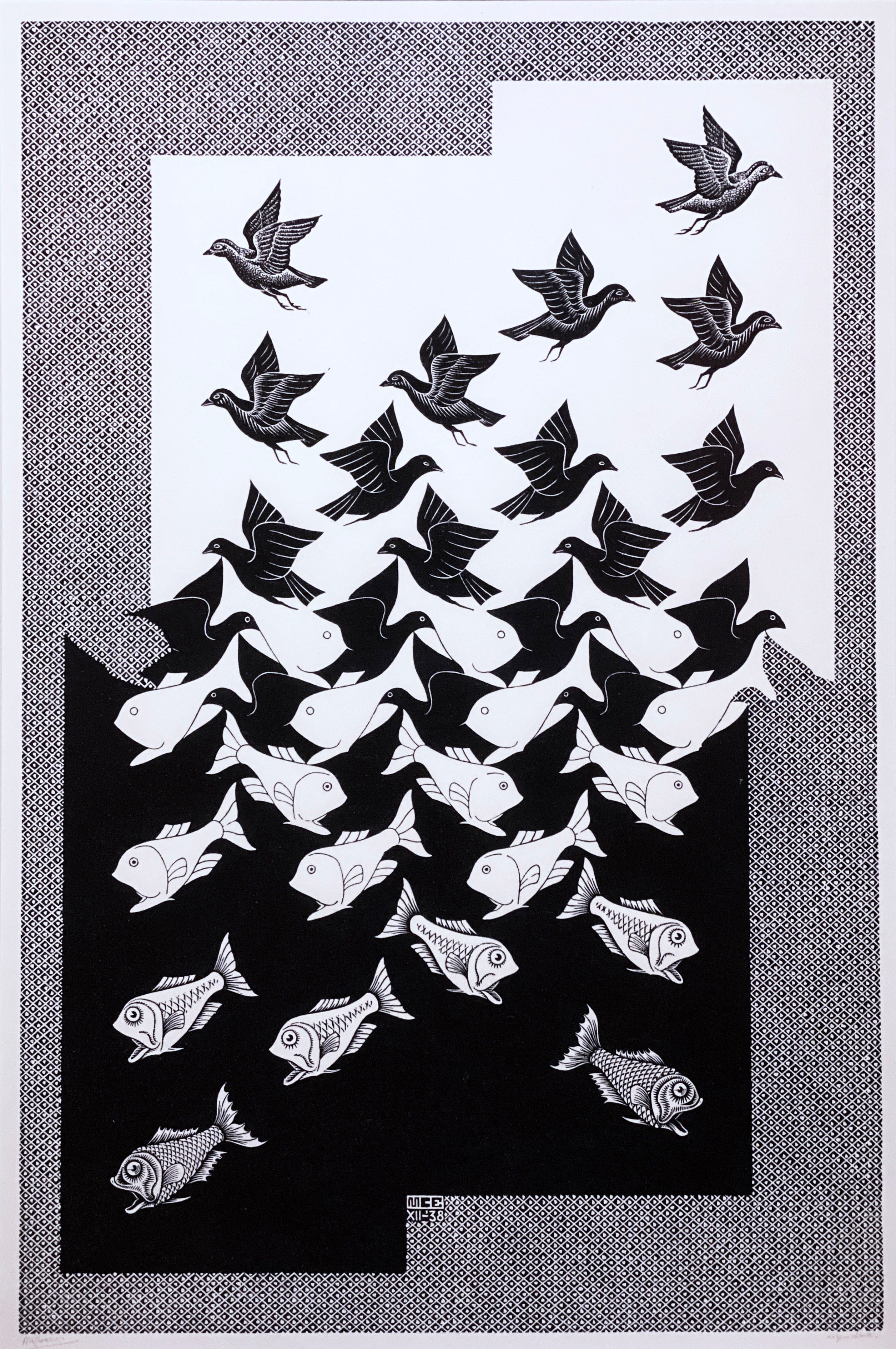
Many modern optical illusions illustrate something like the “mutual arising of opposites” with images that allow two readings at once (vases and faces, ducks and rabbits), and not unlike MC Escher’s work above. But one can also see a more subtle version of the effect in the Chinese ritual bronzes that predate the Daodejing by up to a millennium and were still being made in the Warring States period.
The 11th C BCE example below showcases how the intricate designs on the sides of these vessels often create a similar ambiguity between figure and ground, itself a mutual arising in the visual cortex whenever we look at images.
I'm still playing catch -up, but I have to say ... this remains an incredible treat. And I cannot begin to express my appreciation of your treatment of this study. Thank you so much.
(I've a side bar on the sage myself _mutually_ arising.)/(shamans are screamy monkeys )
as an 80s lad I'd go full subjectless